NERALLT Spring 2010
Boston University
The promised rain did arrive in Boston on April 16th, but was far more like a drizzle much of the time. In fact, even the drizzle took a break once in a while. Since the NERALLT Conference was held in a 9th floor space, the participants were allowed some rather striking views of Boston in between the showers.
Those attending also gained some striking views of the variety of ways in which Language Faculty and Instructional Technology practitioners have been learning to “make do” in a way that often seems an improvement over dedicated software and hardware approaches. (The Schedule, with titles and participants, is repeated at the end of this overview.) Even more striking than the teaching and technology innovations was the highly concise and informative nature of the presentations.
Rebekha Abbuhl, from UC Long Beach (a satellite 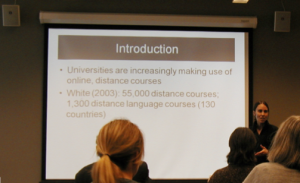 enclave of “New England,” it appears) led off with a very well articulated explanation of how a distance-learning approach to the need for one-on-one English Composition tutoring might be addressed. Her elucidation of how “Elluminate” software
 Kellie Campbell and Hideko Furukawa, from Saint Michael’s College, outlined another sort of “shoestring approach.” Kellie surveyed the various pieces of grant and pilot project
 equipment sitting on her shelves which were now being lightly used and asked Hideko, a Japanese Instructor, if the Japanese classes might benefit from (specifically) the Flip
cameras which were available. Based on Hideko’s learning goals, they were able to arrive at a number of uses. These included dialog recording, as well as “audio exams” which might be done unsupervised, since the video of the FLIP cameras captured what the students were actually doing during the sessions. The substantial impact of this relatively inexpensive technology on the overall course sequence was evident from Hideko’s carefully thought out evaluation of the cameras in her teaching.
equipment sitting on her shelves which were now being lightly used and asked Hideko, a Japanese Instructor, if the Japanese classes might benefit from (specifically) the Flip
cameras which were available. Based on Hideko’s learning goals, they were able to arrive at a number of uses. These included dialog recording, as well as “audio exams” which might be done unsupervised, since the video of the FLIP cameras captured what the students were actually doing during the sessions. The substantial impact of this relatively inexpensive technology on the overall course sequence was evident from Hideko’s carefully thought out evaluation of the cameras in her teaching.
Aneka Meier, of East Stroudsburg University of Pennsylvania, described how the social networking site NING has contributed to the rejuvenation of a languishing German Program. The very sense of community which a site like NING engenders has proved to be just what Aneka needed to create a sense of shared interest within and among her classes. Interestingly, though NING is similar in nature to FaceBook, it is seen by her students as separate, thus not giving students the sense that academia has “invaded” their social world. Though the first portion of this session, in which Aneka outlined the sociology and technology behind using Web 2.0 in the classroom, may have seemed somewhat unnecessary to the particular group gathered at Boston University, it nonetheless provided an extremely well articulated “white paper” for why educators might consider these approaches. The only downside to this presentation was the news from the audience that NING is in the process of becoming a “for pay” site.
The three Poster Sessions each had their own message.
 Audrey Sartiaux, of Union College, provided a very useful overview of the use of audio and other media freeware, combined with “Voicethread,” a very innovative media-driven social networking site, might be leveraged to create real oral-aural interaction among students. Being able to hear of some of the quirks of these free offerings was as useful as the conceptual framework provided.
 Thomas Hammond, of Harvard University, and Gordon Stewart, of Princeton University, provided a thought provoking snapshot of their work on a prototype tool (VGen) which uses a programming approach to discovering which words in a text might need to be glossed for readers learning a language. The fact that VGen is “agnostic” as to the actual language used in its word counts makes it plausible to consider applying it to Foreign Language Sources. Further, the base texts used for comparison may be any text available (such as the Gutenberg site).
 Luke McCarthy, of Norwalk Community College, demonstrated ways in which online audio and video might be incorporated into “homemade” exercises which can fulfill the same rôles as the exercises that the expensive, password protected publishers’ sites provide. He provided material, including a CD that participants might take away for experimentation.
Following the poster sessions, Eduardo Lage-Otero, of Trinity College, provided a broad range of observations on his institution’s transition from Blackboard to Moodle, along the way mentioning the challenges of integrating NanoGong (text and audio) and Kaltura (video) open source applications. The issue of on-campus technical expertise versus “for profit” pre-packaged solutions was evident, but, for those with the time and energy to experiment, it may be possible for an institution or Language Resource Center to provide rich opportunities for relatively little money.
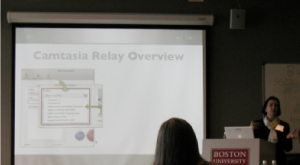 Mary Simone, of UMass Boston, presented the pros and cons of using iTunesU to deliver audio, video, and even text files for course content. Of particular note was the difficulty in coordinating a password protected environment for UMass students. (iTunesU is often used as a public, “PR” sort of presence by colleges and universities.) At the moment, this process is very time intensive for staff, since usernames have to be registered more-or-less manually. The particular video format needed for iTunesU has also required file conversions.
In addition, the issue of copyright has loomed large, and UMass has spent a good bit of time creating a policy. Interestingly enough, SCOLA has allowed for converting video content and reposting it through iTunesU. The NERALLT audience was left with the impression that this approach, while useful to UMass Boston, might be a good fit only for those institutions with a particular sort of departmental infrastructure (both bureaucratic and technical). Camtasia Relay was discussed as a means of recording classroom lectures for on-demand viewing later by students. Mention was made of faculty concerns about class attendance if students “didn’t have to attend” to get content. The video indexing site wwitv.com was also discussed as a means of linking to course videos.
Program Synopsis
Rebekha Abbuhl, Ph.D., California State University at Long Beach - Meeting Student Needs on a Budget: Preparing Teachers to Provide Online Instruction Using Low-cost Resources (Elluminate)
Hideko Furukawa, Kellie Campbell, Saint Michael's College - Using Existing Technologies to “Flip” the Oral Recording Process (Flip Camera)
Aneka C. Meier, Ph.D., East Stroudsburg University of Pennsylvania - Social Networking: Enhancing Standards-based Foreign Language and Culture Learning via the Online Application Platform Ning
Audrey Sartiaux, Ph.D., Union College - Captivating Stories: How to Create Budget Friendly Digital Narratives
Thomas Hammond, Harvard University, Gordon Stewart, Princeton University - VGen: Using Information Retrieval to Predict Learners’ Lexical Challenges
Eduardo Lage-Otero, Ph. D.,Trinity College - Freedom of Speech: Open-source Voice Tools in Moodle
Mary Simone, UMass Amherst - iTunesU and SCOLA
]]>The program for the Spring 2010 NERALLT conference is now available for viewing by clicking on the following link below:
|
Time |
Event |
|
8:00 am |
Registration |
|
8:30-9:30 |
Breakfast |
|
9:30-10:00 |
Welcome Thomas Hammond, Harvard University, NERALLT President John deSenzendeffy, Boston University, NERALLT Conference Host |
|
10:00-10:45 |
Rebekha Abbuhl, Ph.D., California State University at Long Beach- Meeting Student Needs on a Budget: Preparing Teachers to Provide Online Instruction Using Low-cost Resources (Elluminate) To help students obtain the skills they need to successfully complete their studies, universities are increasingly making use of distance learning, including foreign language learning courses. However, while the demand for online language teachers has rapidly increased, language teacher education has been criticized for not adequately preparing preservice teachers for instruction in this new medium (e.g., Compton, 2009; Kessler, 2006). While the reasons for this gap are varied, lack of resources and perceived difficulty of implementation are frequently cited concerns. This presentation will discuss the evolution of English Writing Proficiency, a 10-week online course designed to give preservice English as a second language (ESL) teachers experience teaching online while helping ESL students improve their writing. This presentation will (1) discuss how this online course was shaped into a low-cost service learning opportunity for graduate students preparing to become ESL teachers; (2) cover the use of Elluminate (the licensed software used in the previous iteration of the course); and (3) provide examples of low-cost alternatives to this software that can be used on any campus with internet access. The results of ongoing research on the effectiveness of this course for both ESL writing outcomes and preservice development will also be addressed.
|
|
10:45-11:00 |
Break |
|
11:00-11:45 |
Hideko Furukawa, Kellie Campbell, Saint Michael's College- Using Existing Technologies to “Flip” the Oral Recording Process (Flip Camera) The Language Learning Resource Center (LLRC) at Saint Michael’s College is managed under the Information Technology Department (IT). Many technologies have been purchased in the past with clear purposes. Now, specifically within the LLRC, some of the resources have lost their original purpose or have not been utilized to their optimum potential.
The first goal of this presentation is to present the way in which an existing technology, Flip Video Camera, can be leveraged to its optimum potential. The second goal is to present how to use the Flip Video Camera in order to benefit the oral exercises/activities and the oral exam process in three different level Japanese courses.
There will also be conversation about different ways to leverage specific technologies (like the Flip Video Camera) to specific faculty who would be willing to use the technology in the language classroom. Ideas concerning other uses of the Flip Video Camera, as well as other voice tools, and the pros and cons of each technology will also be discussed. Finally, comments and outcomes for students and faculty will be presented through the results of a survey and an on-campus workshop about using this technology in Japanese and other language courses.
|
|
12:00-12:45 |
Eduardo Lage-Otero, Ph. D.,Trinity College- Freedom of Speech: Open-source Voice Tools in Moodle Trinity College has recently decided to migrate from the proprietary Blackboard Learning Management System to the open source Moodle platform. As part of this transition, the Blume Language Center is evaluating the feasibility of dropping the Wimba Voice Tools in favor of an open source alternative. Instructors have enjoyed the ease of use and variety of features provided by Wimba to develop voice-based language activities. However, the high cost of the Wimba voice tools and the availability of open source alternatives (e.g., the Gong project or the COVCELL project) are strong incentives to explore viable alternatives for language instruction. This presentation will discuss the various voice tools we are considering, their pros and cons, and a potential migration path that would provide a smooth transition for both faculty and students.
|
|
12:45-1:45 |
Lunch/NERALLT Business Meeting |
|
1:45-2:30 |
Audrey Sartiaux, Ph.D., Union College- Captivating Stories: How to Create Budget Friendly Digital Narratives In this poster session, I will show how to use free online applications to create and publish digital stories using voicethread, jaycut and audacity. I will showcase what these programs have to offer and give a live demonstration on how to use them. In addition, I will show an example of a voicethread created by our language Russian assistant for a basic Russian class. Indeed, after having trained our six language assistants to use these applications and explained their pedagogical value in the curriculum, our Russian language assistant developed a successful project to create an online dialogue with her students during one of her lab session. Thomas Hammond, Harvard University, Gordon Stewart, Princeton University- VGen: Using Information Retrieval to Predict Learners’ Lexical Challenges Developing effective materials and L2 proficiency measures can be both time-consuming and extremely expensive. Although the internet connects teachers and learners to a vast array of texts in nearly any language imaginable, selecting and preparing texts for L2 readers is a a daunting task. Although experienced teachers can often identify the words with which learners will struggle, the task of combing through the text is painstaking, and the results sometimes miss the mark.
The presenters will showcase a prototype tool, VGen, that uses methods from information retrieval to identify the salient vocabulary in a text. The tool uses the term frequency–inverse document frequency score (TFIDF) to ranks each word in the text based upon the intersection of two measures: high frequency in the text (proxy for importance to the text’s meaning) and low frequency in the corpus (filters out function words like the and ubiquitous content words that most L2 readers would have encountered already. This procedure produces a rank-order list of terms that merit the most attention in pre-teaching or in testing.
In practice, TFIDF ranking appears to be a good proxy for word importance and difficulty. However, in further work the presenters plan to use experimental data to build a classification engine, possibly based upon cluster analysis, to identify more accurately the key terms in a text.
Although work to date has been done with English texts, the VGen tool itself is languagee neutral. The presenters are eager to collaborate with others who might like to apply the tool to texts/corpora in other languages.
Luke McCarthy, Norwalk Community College- Using Online Resources and a Little “Know-how” to Build Complete Language Learning Units Over the past few years, publishers have been moving toward online-based language learning packages away from CD-ROM and networked based ones. The cost of these per-student-online-accounts can be substantial when approached from a semester or yearly basis. This session will explore ways language technology professionals can combine online video, audio, and other resources with ready-made templates, a little “know-how”, and some creativity to create individual language learning exercises to complete units at little to no cost. These language units/exercises provide basic student tracking but can be expanded depending how involved language professionals want to be with their creations. A free CD-ROM with the templates, examples, and resources presented will be provided.
|
|
2:30-3:15 |
Aneka C. Meier, Ph.D., East Stroudsburg University of Pennsylvania- Social Networking: Enhancing Standards-based Foreign Language and Culture Learning via the Online Application Platform Ning This presentation focuses on the use of social networking sites as a student-driven, collaborative, and highly interactive tool for foreign language and culture learning. It describes the ways online communities, such as Facebook, engage our students today, who belong to the ‘Web 2.0’ generation of so-called ‘digital natives.’ I will discuss how I have very successfully implemented Ning in my college-level German language classes and how I use it as a course management system. Ning provides a free online application platform for creating individual networks on particular topics of a user’s choice, and has become increasingly popular among educators. As it offers students a fun way of learning and allows the instructor to facilitate a strong sense of community, Ning has the potential to immerse students in a foreign language and lead to the achievement of collective language learning goals.
|
|
3:15-4:30
|
Mary Simone, UMass Amherst- iTunesU and SCOLA This presentation describes the distribution of audio, video, and text files through an iTunesU course for Chinese 105, a Chinese language course for heritage speakers at UMASS Boston. UMASS Boston. The launch of the public face of iTunesU at UMass Boston two years ago made it possible for faculty to upload course content that was available to all who accessed the site http://www.itunes.umb.edu/. Many faculty prefer to have their course content only available through password authentication and not available to the general public. IT has been working towards this goal. Over the last several months, two language course professors have been piloting private authentication for their students to access their iTunesU courses. This presentation will briefly describe the workflow associated with this process and the technical challenges encountered. iTunesU at UMASS Boston can consolidate many of the various media content a professor uses in a course into one learning tool to simplify course management. For example, Chinese 105 uses a variety of rich content in the form of pdf, audio and video files delivered through multiple tools. There are videos from classroom capture skits, audio narrations from students, and audio recordings from the publisher. and videos from YouTUBE, and SCOLA. The professor and her students capture original content through flip video and original audio through mp3 recorders and distribute these through a wiki, blog, and Blackboard. In order to deliver the various media content formats through iTunesU, it has been necessary to convert media content. In order for a course to deliver the diverse media content from different sources, it has been necessary to set up copyright policies for faculty that set up guidelines for uploading content and maintaining content on-line as well as receiving permission to use content. Another part of this project has involved training faculty to manage their own iTunesU content once a course has been created. This presentation will also describe the development and delivery of training materials for faculty.
|
|
4:30-5:15 |
Tour of Geddes Language Center |
CALL FOR PROPOSALS
The New England Regional Association for Language Learning Technology Spring 2010 Conference, Boston University, April 16th, 2010
LANGUAGE LEARNING ON A SHOE STRING: SUPPORTING FOREIGN LANGUAGE LEARNERS ON A TIGHT BUDGET
Each week, across the country, the media publishes stories about the current economic downturn and its adverse effects on the financial standing of many colleges and universities. Reductions in budgets and/or staffing often place faculty and staff in the challenging position of supporting learner while managing more work that needs to be done in less time with fewer resources. This trend has forced many supporters of language learning to rethink how we can continue to provide a wide variety of resources and programs with limited time and funds.
In response, the New England Regional Association for Language Learning Technology will devote its Spring meeting to exploring and showcasing ideas for creative solutions that deliver language learning opportunities and resources in these hard economic times. The conference will be hosted by Boston University on April 16, 2010. We invite proposals for papers, panels, and posters focusing on productive responses to new challenges in supporting foreign language learning and instruction.
Suggested topics include:
- Using freeware and open source software to replace costly licensed software.
- Bringing in outside speakers via web conferencing.
- Using technology to bring culture into the classroom when study abroad is not possible.
- Making the time for ongoing assessment of students' language proficiency using technology.
- Optimizing efficiency by utilizing services such as course management systems, self-paced tutorials, Web 2.0 technology to create out-of-class learning opportunities
- Adopting effective techniques for tracking language resource usage by faculty and learners to target efforts.
- Applying for additional funding sources to support language resources at your institution.
- Implementing green-computing (desktop virtualization, power management, paperless classroom, thin clients/IT initiatives).
- Fostering inter-departmental and/or inter-institutional partnerships to develop resources and extend services.
- Re-imagining collaboration between classroom faculty and organizers for various campus venues to optimize access to resources and media sources.
Proposals should be submitted online for 30-45 minute presentations or demonstrations, 45-60 minute panel discussions, 25-minute posters, or 3-hour pre-conference workshops. We welcome a variety of perspectives and encourage presentations that report on ongoing projects or research.
For more information, please contact: Michelle Cheyne (mcheyne@umassd.edu) or John Graves (j.graves@yale.edu )
Proposal deadline: Monday, March 1, 2010 by 5:00 pm
Notification of acceptance: Monday, March 8, 2010
]]>The New England Regional Association for Language Learning Technology will hold a joint conference at Boston University April 16th, 2010.
The conference theme will be: